HRMS and Payroll Software in India: One Platform vs Separate Tools
Compare HRMS and payroll software in India. Explore integrated platforms vs separate tools, their pros and cons, costs, and how Peeplynx HRMS supports your growing business.
As Indian businesses grow, two systems quickly become essential: an HRMS to manage people, and payroll software to pay them correctly and stay compliant. The question most teams face is whether to run HRMS and payroll software as one platform or as separate, best-of-breed HR tools. Both approaches work, and both carry trade-offs. This guide breaks them down so you can choose what fits your team today and as you scale.
Explore the Feature
Indian Payroll
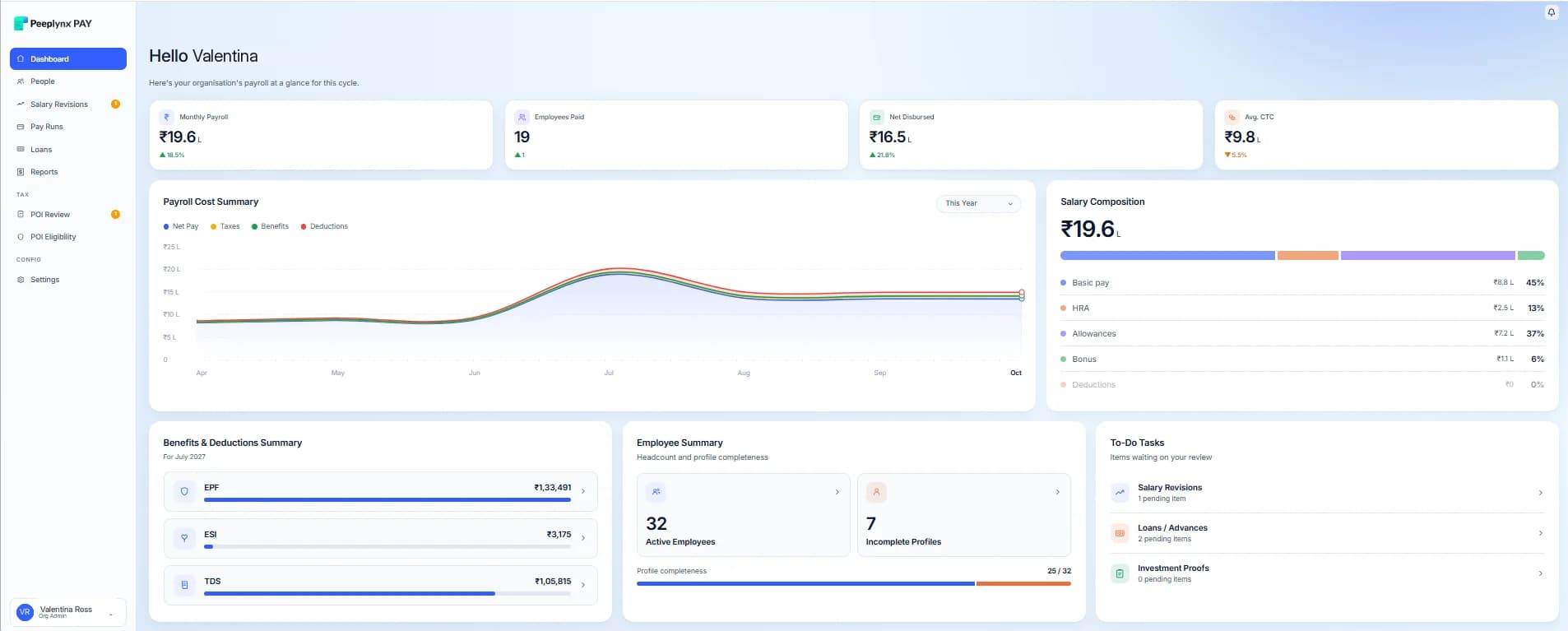
See how Peeplynx HRMS calculates PF, ESI, PT, and TDS from the same employee, attendance, and leave records your HR team already maintains.
What's the Difference Between HRMS and Payroll Software?
An HRMS and a payroll system solve neighbouring problems, and teams often buy them as if they were the same product. They are not. Knowing where each one starts and stops is what makes the one-platform versus separate-tools decision concrete.
What HRMS Software Does
An HRMS manages the employee lifecycle — records, attendance, leave, and performance — giving HR a single place to run day-to-day people operations. In Peeplynx HRMS, those records live in Workforce Central, so joining, updates, and exits stay on one employee profile.
What Payroll Software Does
Payroll software calculates pay and statutory deductions — PF, ESI, PT, and TDS in India — then produces payslips, filings, and payments accurately every cycle. Indian payroll software is where those statutory rules are applied, not in the HR record itself.
Where They Overlap
The two meet at data: payroll depends on accurate employee records, attendance, and leave to run correctly. How that data gets from HR into payroll is the real question behind the one-platform-versus-separate-tools debate. When the handoff is manual, it becomes one of the hidden costs of manual payroll.
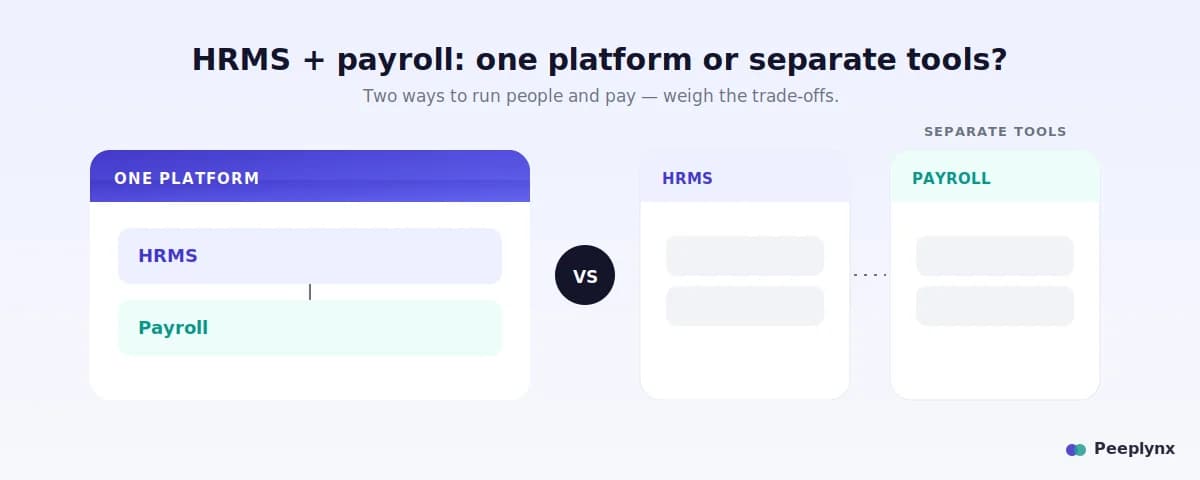
The Integrated Suite (One Platform)
An integrated suite offers integrated HRMS and payroll within a single system, so HR and pay data live together and teams work from one login. HRMS with payroll software means a joiner, a leave change, or a salary revision is entered once and is already available for the next pay run.
Best-of-Breed (Separate Tools)
The best-of-breed approach pairs a specialist HRMS with specialist payroll software, each chosen on its own merits and connected as needed. Best-of-breed HR tools can be the stronger choice when one process — payroll compliance, or a deep HR workflow — is far more demanding than the other.
Pros and Cons of an Integrated HRMS + Payroll Platform
An integrated platform trades some freedom to swap vendors for less reconciliation. For many teams, that trade is the point.
- Pros: one login and one vendor, shared employee data, simpler onboarding, and a consistent experience across HR and pay
- Cons: a suite can be stronger in one area than the other, and consolidating on a single vendor reduces flexibility if your needs change
Pros and Cons of Separate HRMS and Payroll Tools
Separate tools keep each purchase focused. The cost shows up in the gap between them.
- Pros: best-in-class capability in each area and freedom to swap one tool without replacing the other
- Cons: data must move between systems, you manage two vendors and renewals, and reconciliation adds effort — one of the quiet hidden costs that grows with headcount
One Platform vs Separate Tools: A Comparison
The same factors decide the fit for most Indian teams. Read each row against how your HR and finance teams work today.
- Data consistency — an integrated suite shares records by design; separate tools depend on transfers, exports, or an integration that someone has to maintain
- Specialization — an integrated suite is broad and even; separate best-of-breed HR tools go deep in each area
- Vendor management — one vendor versus multiple contracts, renewals, and support contacts
- Flexibility — lower when you consolidate; higher when you can swap any tool
- Onboarding effort — simpler on one platform; more coordination when HR and payroll are implemented separately
- Best for — teams that want simplicity, versus teams with a specific process that a general suite does not cover well
For Small Businesses and SMEs
For payroll and HRMS for SME teams, simplicity usually wins — fewer tools, fewer logins, and less reconciliation matter more than deep specialization. The priority is accurate, compliant pay without a large HR function. HRMS payroll software that already includes employee records is usually enough until the people processes outgrow it.
For Growing and Multi-Location Teams
As you scale across locations, data consistency and statutory accuracy become critical. Payroll software for growing businesses that keeps pace with new states and entities matters more than any single feature — especially when attendance and leave are captured in different places from pay. HR automation software only helps here if the HR record and the pay run read the same data.
Questions to Ask Vendors
Ask these in a demo, with your own pay scenarios, rather than accepting a feature list.
- Does the payroll handle Indian compliance — PF, ESI, PT, and TDS — accurately and across states? Indian payroll should show the calculation, not only the payslip
- How do employee, attendance, and leave data reach payroll, and how much of that movement is still manual?
- Who can see salary data — does it support role-based access control?
- Can we start with one part and add the other later without re-implementing?
Where Peeplynx Fits
Peeplynx HRMS gives you both a modern HRMS and purpose-built payroll software — so you are not forced to choose between a one-size-fits-all suite and a patchwork of disconnected tools. You can start with the piece you need most and add the other as you grow, getting specialized tools and a consistent experience from a single vendor.
See how it maps to your industry, or review transparent pricing.
Frequently Asked Questions About HRMS and Payroll Software
What is the difference between HRMS and payroll software?
An HRMS manages people — records, attendance, leave, and performance — while payroll software calculates pay and statutory deductions and produces payslips and filings. They overlap because payroll relies on HR data.
Is integrated HRMS and payroll better than separate tools?
Neither is universally better. Integrated HRMS and payroll favours simplicity and shared data; separate tools favour specialization and flexibility. The right choice depends on your team's size and needs.
What is best for an SME — HRMS with payroll software or separate tools?
Most SMEs value simplicity and compliant pay over deep specialization, so fewer tools and fewer handoffs usually fit best — provided the payroll software handles Indian statutory compliance accurately.
Can I use payroll software without a full HRMS?
Yes. Many teams run payroll software on its own and add HRMS capabilities later as their people processes grow. Peeplynx HRMS is built so you can start with payroll and add the rest of the HR record without a second implementation.
Does HRMS payroll software handle Indian compliance (PF, ESI, PT, TDS)?
Good HRMS payroll software — whether part of a suite or standalone — automates PF, ESI, PT, and TDS and keeps rates current for accurate, filing-ready output.
Ready to See HRMS and Payroll in Action?
The best way to judge fit is to see it work with your own scenarios. Request a demo of Peeplynx HRMS and explore HRMS and payroll together — including how attendance, leave, and pay share one employee record.
Keep reading: Payroll Software for Growing Businesses, Payroll Software: Benefits of Switching to Automated Payroll, and Manual Payroll: The Hidden Costs to Your Business.
Keep Reading
HRMS Features
Probation Management in HRMS: How Peeplynx Confirms Employees on Time Without Manual Chasing
Learn how probation management in HRMS tracks end dates, starts evaluations on time, and issues confirmation or extension letters without HR chasing managers by email.
Payroll
Manual Payroll: The Hidden Costs to Your Business
Manual payroll isn't free. Discover the hidden costs of manual payroll - time, errors, compliance risk - and how payroll software from Peeplynx HRMS fixes them.
Ready to see it in action?
See how Peeplynx simplifies HR for your team.
From attendance and leave to performance and service desk - explore the full platform in a live demo.