Manual Payroll: The Hidden Costs to Your Business
Manual payroll isn't free. Discover the hidden costs of manual payroll - time, errors, compliance risk - and how payroll software from Peeplynx HRMS fixes them.
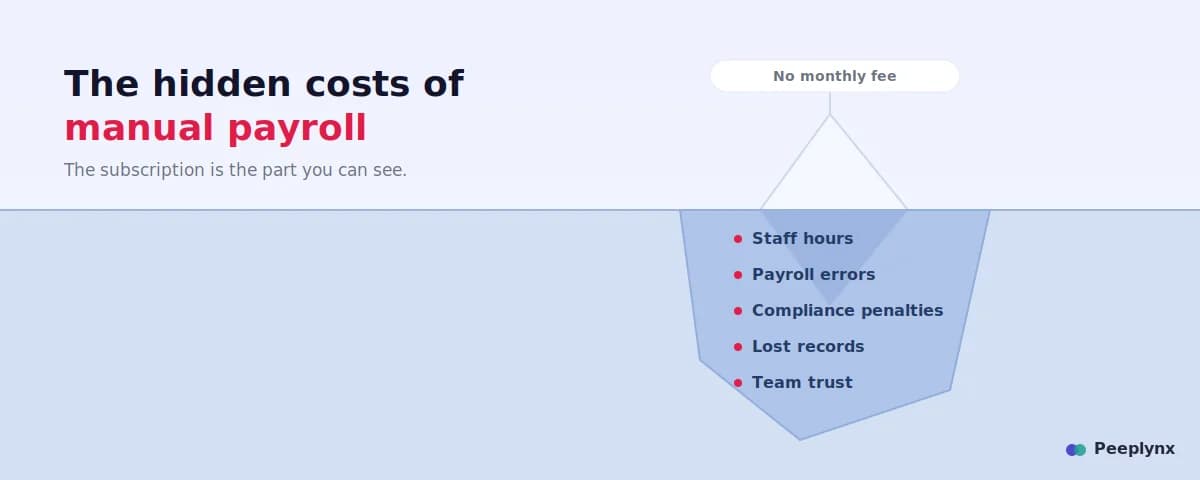
When businesses weigh up payroll software, the conversation often starts with price. That is understandable — but it misses half the picture. Manual payroll is not free just because there is no monthly subscription attached to it. It carries costs; they are just spread out, easy to overlook, and paid in ways that never show up on a single invoice. This guide breaks down what manual payroll really involves, the hidden costs it creates, and how switching to dedicated payroll software — such as Peeplynx HRMS — removes them.
Explore the Feature
Indian Payroll
See how Peeplynx HRMS replaces manual payroll with automated calculations, statutory compliance, and employee self-service — all from connected attendance, leave, and employee records.
What Is Manual Payroll?
Manual payroll is any pay process that relies on people rather than automation to do the heavy lifting — typically spreadsheets, manual tax calculations, and hand-checked payments. It can work for a very small team, but every step depends on someone remembering to do it, doing it correctly, and doing it on time. That dependence is where the hidden costs come from.
How Manual Payroll Works
A typical manual payroll processing cycle runs like this: someone collects attendance and leave data, calculates gross pay for each employee, applies deductions and taxes by hand, prepares the payments, issues payslips, and files the necessary returns. Every one of those steps is performed or double-checked by a person, every cycle, with no automatic safeguard if a number is wrong.
Why Manual Payroll Still Exists
Many businesses stick with manual payroll because it feels free and familiar — there is no software to buy and no new system to learn. For a handful of employees it can genuinely be manageable. The problem is that the true cost of manual payroll stays invisible until the business grows, at which point the hours, errors, and compliance risks scale right along with the headcount. That is why payroll software for growing businesses is usually adopted just as these costs start to surface.
The Hidden Costs of Manual Payroll
The costs below rarely appear on any budget line, which is exactly why manual payroll seems cheaper than it is. Understanding each one makes the case for switching to payroll software far clearer.
The Cost of Time
Someone in your business spends hours on payroll every cycle — gathering hours worked, calculating pay, applying deductions, checking figures, processing payments, and filing taxes. That time has a price even if no one is invoicing for it: it is time not spent on customers, strategy, or growth. Payroll automation collapses this work into a fraction of the time, so the cost quietly disappears rather than being reassigned somewhere less visible.
The Cost of Payroll Errors
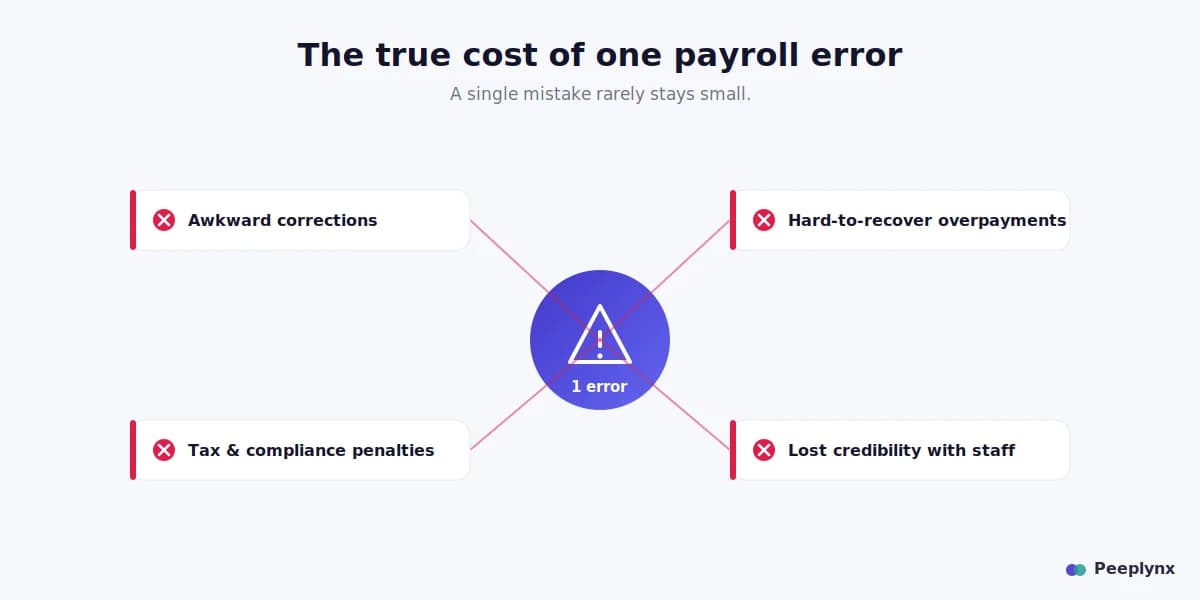
A single payroll mistake rarely stays small. An underpayment means an awkward conversation and a correction; an overpayment can be hard to recover; a miscalculated tax figure can trigger penalties. Payroll errors are not a matter of if but when with manual processes — not because people are careless, but because repetitive manual calculation always produces mistakes eventually. Automated payroll applies the same correct logic every time, which is the only reliable way to keep the error rate near zero.
The Cost of Compliance Risk
Tax and labour rules change, and the responsibility to keep up sits with you. With manual payroll, staying compliant depends on someone noticing every relevant update and applying it correctly — a lot to ask, with significant penalties for missing something. Payroll compliance software absorbs much of this risk by keeping tax rates and filing requirements current automatically, so compliance drops from constant vigilance to a task the system handles.
The Cost of Poor Records
Manual payroll tends to scatter information: a spreadsheet here, a printed stub there, an email confirming a bonus. It works until the moment you need something specific — for an audit, a dispute, or an employee request — and then it becomes hours of digging. Payroll software keeps everything in one structured, searchable place, so retrieving a record is trivial rather than a project.
The Cost to Your Team
When payroll is late, wrong, or opaque, employees notice. Trust erodes, and a stressed employee wondering whether their pay is correct is not doing their best work. Software supports consistent, on-time payments and gives employees self-service access to their own pay information — so the workforce simply stops worrying about payroll, which is exactly how it should be.
How Payroll Software Removes These Hidden Costs
Where manual payroll spreads cost across time, errors, and risk, payroll management software is designed to remove each one at the source.
Payroll Automation
Automated payroll runs the repetitive steps for you — calculations, deductions, payslips, and filings — so the hours that manual payroll consumes largely disappear. Payroll automation software also flags anything unusual before you commit a pay run. For Indian businesses, Indian payroll software handles statutory calculations like PF, ESI, PT, and TDS automatically — exactly where manual methods are most error-prone.
Payroll Accuracy
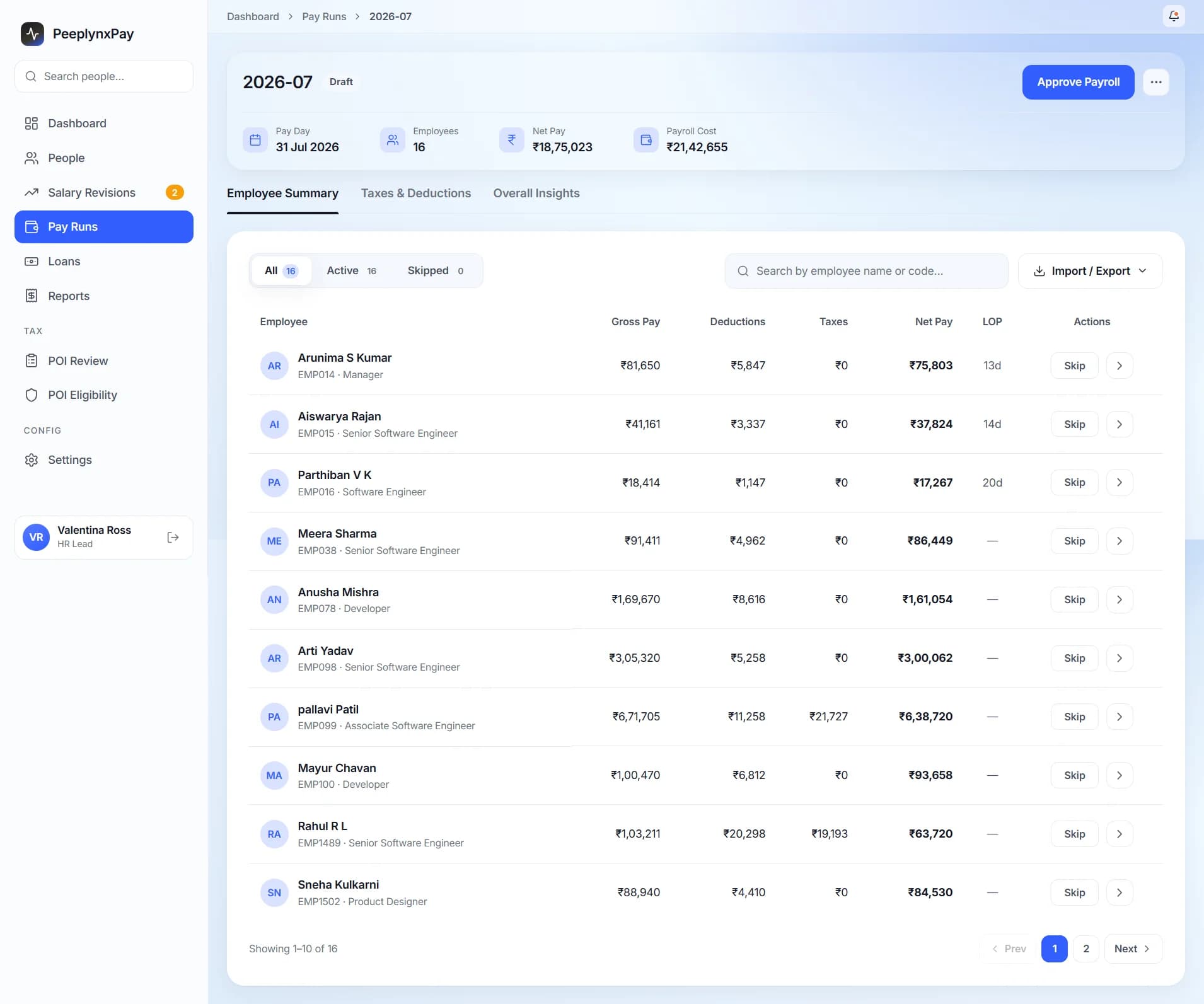
The system validates inputs, applies consistent rules, and highlights anomalies, so payroll accuracy no longer rests on manual double-checking. Correct pay, correct deductions, and correct filings become the default rather than the goal.
Payroll Compliance
Current tax tables, correctly formatted statutory outputs, and a complete audit trail mean your payroll stands up to scrutiny if you are ever asked to produce records — removing the compliance-risk cost entirely. Pairing this with role-based access control ensures sensitive salary data is only visible to the people who need it.
Centralized Records and Reporting
With every payslip, filing, and payment stored in one place, records stop being a liability. Payroll reporting turns that same data into cost breakdowns and summaries you can actually use for budgeting.
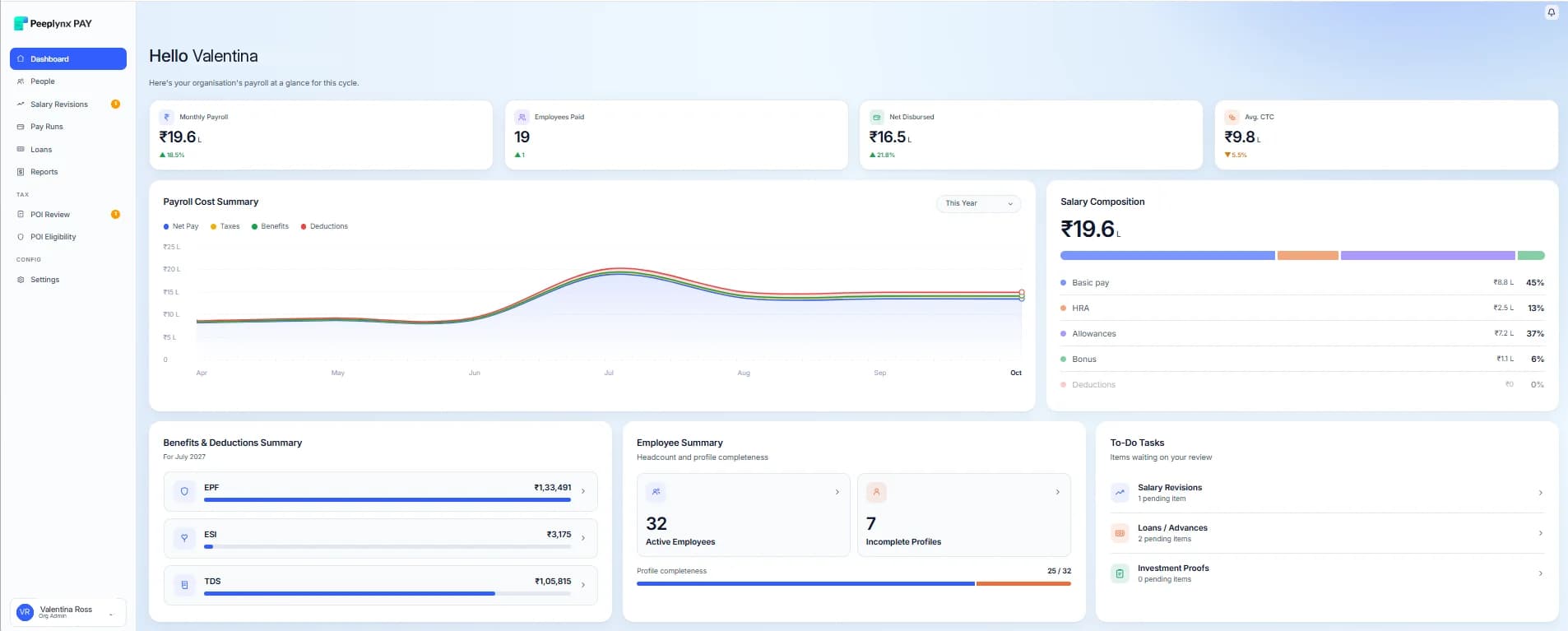
Employee Self-Service
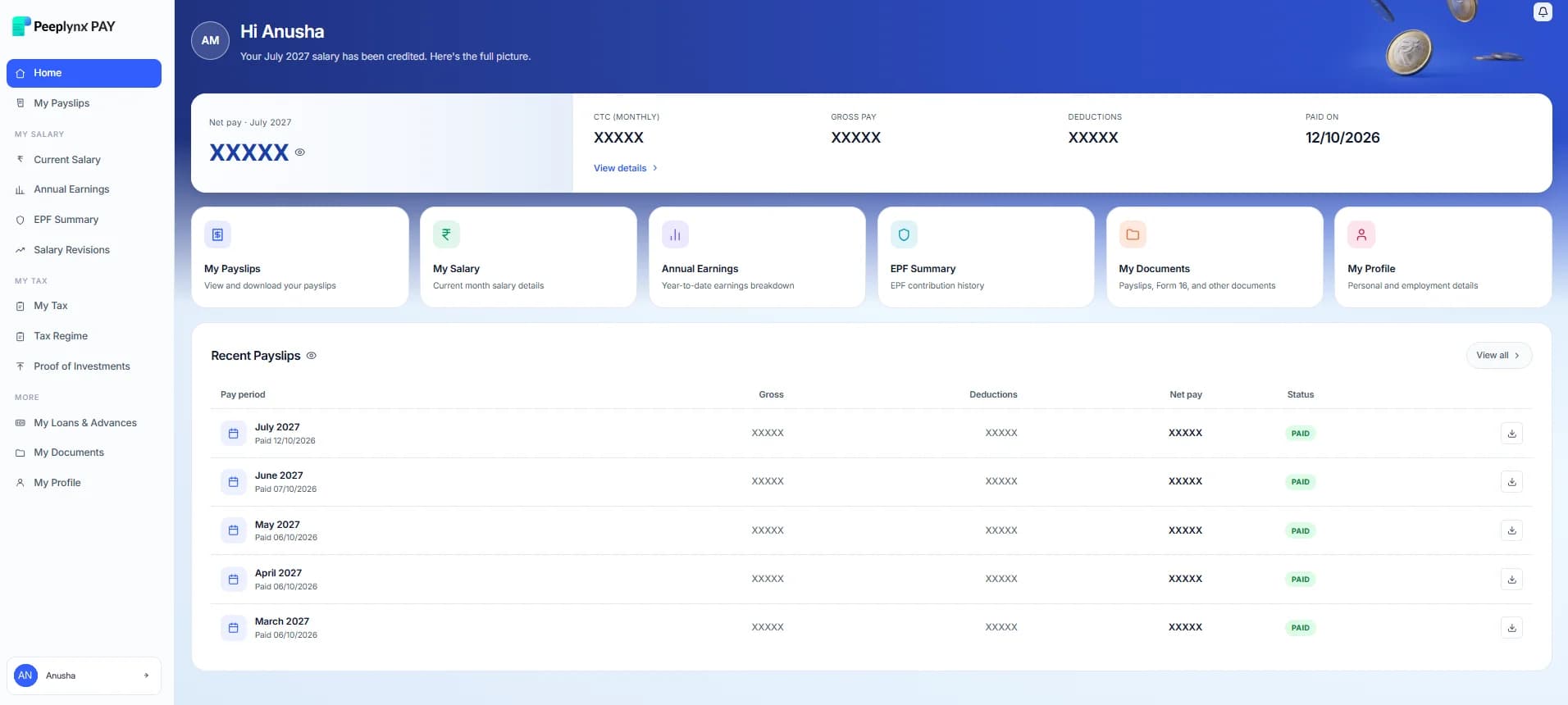
Employee self-service payroll lets staff view payslips, download tax documents, and update their own details — cutting the queries that eat into HR's time and giving employees confidence their pay is handled properly.
Manual Payroll vs Payroll Software: A Cost Comparison
Set side by side, the hidden costs of manual payroll become easy to see — and so does the difference payroll software makes.
- Staff time per cycle — Manual payroll is high and recurring; with payroll software it is minimal.
- Error correction — Manual payroll means frequent, reactive fixes; with payroll software errors are rare.
- Compliance penalties — Manual payroll carries ongoing risk; with payroll software penalties are largely avoided.
- Record retrieval — Manual payroll relies on slow, manual searches; payroll software keeps records instant and centralized.
- Employee trust — Manual payroll puts trust at risk; payroll software reinforces it.
The Data That Drives Accurate Payroll
Accurate payroll depends on accurate inputs. Whatever tools you use, the quality of a pay run comes down to the employee, attendance, and leave data behind it — so getting those inputs right is where cost and errors are won or lost.
- Employee data — Accurate pay starts with accurate employee records — salary details, joiners, and leavers. Keeping this employee data clean and current in Workforce Central is the foundation every correct pay run is built on — the same connected record that employee lifecycle management software relies on from onboarding through exit.
- Attendance — Hours and overtime feed pay. Sourcing them from a reliable attendance management system — rather than rekeying them — removes a major source of error at the payroll stage. See how an employee attendance management system supports payroll accuracy.
- Leave — Approved leave affects pay and balances. Up-to-date records from a leave management system mean the right adjustments make it into payroll without last-minute reconciliation. Explore automated leave approvals in more detail.
- Payroll inputs — Alongside hours from attendance management and approved leave management, variable inputs — bonuses, reimbursements, one-off deductions — need to be captured accurately for the period, so the person running payroll is reviewing figures rather than chasing them. Approved reimbursement requests can flow in from Connect Desk instead of a side spreadsheet.
How to Reduce Payroll Costs in Your Business
- Automate the repetitive steps first. Calculations, deductions, and payslip generation are where manual effort and errors concentrate — the same principle behind broader HR automation.
- Work from accurate inputs. Sourcing attendance and approved leave from reliable records — rather than rekeying them — removes double entry and the errors that come with it.
- Centralize your records. One system of record makes audits and employee requests fast instead of stressful.
- Plan for growth. If you are scaling, choose payroll software for growing businesses that adds employees and locations without a re-implementation — whether you are a startup or an enterprise.
- Compare plans realistically. Weigh the predictable cost of payroll software against the hidden cost of the manual hours it replaces, and review transparent pricing before you decide.
Why Choose Peeplynx HRMS for Payroll
Peeplynx HRMS replaces the manual effort behind payroll with automation built for accuracy and compliance — consistent calculations, current statutory rates, clean records, and self-service access for employees. That means fewer hours lost, fewer errors to correct, and less compliance risk to carry. See how it maps to your industry, explore the broader HRMS software, or review transparent pricing.
Frequently Asked Questions About Manual Payroll
Is manual payroll really more expensive than payroll software?
Often, yes — once you account for staff hours, error corrections, compliance risk, and disorganized records. Those costs are hidden because they never appear on a single invoice, unlike a software subscription. Learn more about the benefits of switching to automated payroll.
What are the biggest risks of manual payroll?
The most common are calculation errors, missed or incorrect tax filings, and compliance penalties, along with the slow retrieval of records when you need them most.
Can payroll software eliminate payroll errors entirely?
No system eliminates every possible error, but payroll software dramatically reduces them by applying consistent logic and keeping tax rules current, rather than relying on manual calculation each cycle. Indian Payroll in Peeplynx HRMS applies PF, ESI, PT, and TDS inside the same pay run.
How much time does payroll software actually save?
It varies by business size, but tasks that take hours manually — calculations, payslips, and filings — typically shrink to minutes, since the system does the repetitive work automatically.
When is the right time to switch from manual payroll?
As soon as the hidden costs start to bite — usually as headcount, pay complexity, or compliance obligations grow. Switching before a busy period or an expansion avoids changing something fundamental under pressure. Book a demo to see the setup path for your team.
Ready to Cut the Hidden Costs of Manual Payroll?
None of these costs appear on a bill, which is precisely why manual payroll feels cheaper than it is. Put them together — the hours, the errors, the compliance exposure, the messy records, the strain on your team — and the free option starts to look expensive. See how automated payroll removes them: request a demo of Peeplynx HRMS.
Keep Reading
Payroll
Payroll Software for Growing Businesses
Discover how payroll software for growing businesses scales with headcount, new locations, and complexity — and how Peeplynx HRMS grows with you.
HR Tech
Bilingual HRMS Software: Why It's an Architecture Decision, Not a Feature
Learn why bilingual HRMS software needs to be built into the core architecture from day one — and why bolt-on language support creates problems after rollout.
Ready to see it in action?
See how Peeplynx simplifies HR for your team.
From attendance and leave to performance and service desk - explore the full platform in a live demo.