Bilingual HRMS Software: Why It's an Architecture Decision, Not a Feature
Learn why bilingual HRMS software needs to be built into the core architecture from day one — and why bolt-on language support creates problems after rollout.
Most HR platforms treat a second language as a feature to check off — a translated string table sitting on top of an interface that was designed in one language and one direction. Peeplynx HRMS takes a different position: bilingual HRMS software isn't something you add later; it's a decision that has to be made at the architecture level, before a single screen is designed.
This distinction sounds subtle until you try to retrofit it. This article explains what it actually means to build a bilingual HRMS architecture rather than a translated one, why the difference matters for HR teams and employees alike, and how this shows up in the way Peeplynx HRMS is structured underneath the interface.
Explore the Feature
Bilingual Support
See how Peeplynx HRMS delivers a fully localized experience — menus, forms, notifications, and letters — across every module and role.
What Is Bilingual HRMS Software?
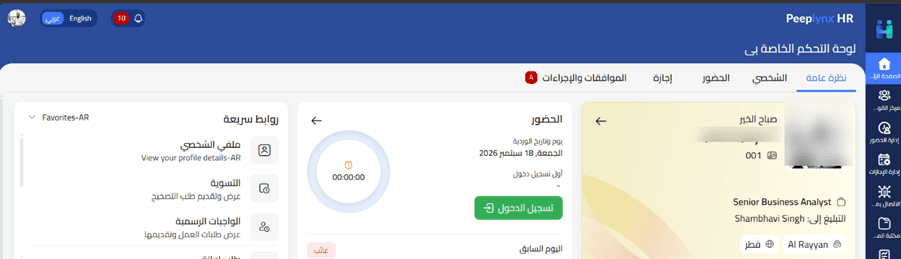
Bilingual architecture in HRMS software means that language support is a structural property of the system, not a display-layer translation applied on top of it. Every screen, workflow, notification, letter, and report is designed from the ground up to render correctly in more than one language — not just the buttons and labels, but the actual data entered by users.
In practice, this means a genuinely bilingual HRMS platform treats each of the following as first-class, not optional, concerns:
- Every user-facing field can capture and display content in more than one language simultaneously, not just the UI chrome
- Layout direction is a configurable property of the interface, not a one-off CSS override applied late in development
- Generated documents — letters, notifications, and reports — carry the same bilingual support as the live interface, not a separate translation process
- Language preference is scoped per user, per tenant, and per document, rather than applied globally across the whole system
Why Bilingual Support Should Be an Architecture Decision
When language support is added after a platform is already built, it tends to surface as a string-replacement exercise — swap the label text, leave the underlying data model, workflows, and document templates untouched. That approach works for marketing pages. It breaks down fast in an HRMS, where the same employee record, approval workflow, or letter template has to hold content in more than one language at once, correctly, for years.
Common failure points when bilingual support is treated as a feature rather than an architecture decision:
- Data fields only store a single language, so switching the interface language doesn't translate content the employee or HR admin actually entered
- Approval workflows and notifications default to one language regardless of the recipient's preference
- Generated letters and documents are only available in the language the template happened to be built in
- Reports and exports mix languages inconsistently because the underlying schema was never designed to separate display language from stored data
- Every new module added to the platform requires a fresh, manual localization pass instead of inheriting bilingual support automatically
Key Capabilities of a Bilingual HRMS Platform
A bilingual HRMS software platform built at the architecture level typically includes:
- Dual-language data capture on core fields, so records genuinely hold content in more than one language rather than a single translated label
- Configurable layout direction that applies consistently across every module, not patched in screen by screen
- Bilingual notifications and in-app alerts that respect each recipient's individual language preference
- Localized document generation, so letters and official communications are produced natively in the required language rather than translated after the fact
- A component library where every new page or module inherits bilingual support automatically, instead of requiring a separate localization effort
What Happens When Bilingual Support Is Added Later?
Organizations that adopt single-language HR software and then attempt to bolt on bilingual HR software capabilities later tend to run into the same recurring issues:
- Inconsistent employee experience — some screens are fully localized, while others remain in the original language
- Broken layouts — text length, direction, and alignment assumptions don't hold once a second language is introduced
- Duplicate data entry — HR teams maintain parallel records or documents in each language
- Rising maintenance cost — every future feature requires its own dedicated localization effort
- Low adoption — employees disengage from self-service tools that were only partially localized
Bilingual HRMS vs. a Basic Translation Layer
A basic translation layer takes an existing single-language interface and swaps out visible text using a lookup table. It's fast to implement and looks complete in a demo — but it only addresses what's on screen, not what's underneath it.
A true bilingual HRMS architecture works differently:
- Language is a property of the data itself, not just the interface displaying it
- Layout direction and typography are handled as configurable system behavior, not manual per-screen adjustments
- New modules and features inherit bilingual support by default
- Generated documents, notifications, and reports are natively bilingual, not translated as an afterthought
Benefits of Bilingual HRMS Software Across the Employee Lifecycle
Building bilingual support into the architecture pays off at every stage of the employee lifecycle:
- Onboarding — new hires complete forms and review policies in the language they're most comfortable with, improving accuracy and adoption from day one
- Leave management — employees and approvers interact with Leave Management requests in their preferred language without translation delays
- Performance reviews — Performance Management feedback and goal-setting stay clear when employees and reviewers work in their own language
- Employee communication — announcements and updates sent through Connect Desk reach every employee in a language they understand
- Exit management — final documentation and letters are generated correctly in the required language without a manual translation step
Bilingual HRMS Requirements Across Industries
The need for structural bilingual support varies by workforce composition and region. What counts as the right HR software for a multilingual workforce in healthcare looks different from what a distributed retail chain needs, even though both are multilingual HRMS problems. Explore how Peeplynx HRMS adapts across industries.
- Multinational enterprises — large organizations need consistent bilingual support so HR processes don't fragment by location
- Manufacturing and retail — distributed workforces often depend on genuine localization for self-service adoption
- Healthcare — clear language matters for policy acknowledgment and compliance documentation
- Education — institutions need consistent language support across academic and non-academic roles
- Small businesses and startups — growing companies need language support that scales without re-platforming later
How to Evaluate Bilingual HRMS Software
- Check whether data fields store content per language or only display translated labels over a single stored value
- Confirm that layout and direction handling is a system-wide configuration, not a per-screen patch
- Ask whether newly released modules automatically inherit bilingual support
- Verify that generated documents and notifications are natively bilingual
- Test with real content in each language before rollout
- Review whether language preference is scoped per user, per tenant, or globally
Why Choose Peeplynx HRMS for Bilingual Support
Peeplynx HRMS is built as a multi-tenant, localized HR software platform where bilingual support is part of the core architecture rather than layered on top of it.
- Dual-language fields across core modules
- Configurable layout direction across every screen and module
- Bilingual notifications, letters, and generated documents
- A component architecture where new modules inherit bilingual support automatically
- Cloud and on-premise deployment options for regional data-residency requirements
Frequently Asked Questions About Bilingual HRMS Software
What does it mean for bilingual support to be an architecture decision?
It means language support is built into the data model, component library, and document generation layer from the start, so every module and record supports more than one language by default.
How is this different from a translated HR software interface?
A translated interface swaps visible labels but typically leaves the underlying data and documents tied to one language. A structural bilingual architecture allows the same record, notification, or letter to genuinely exist in more than one language.
Does structural bilingual support cost more to implement?
It requires more upfront design work, but removes the recurring cost of manually localizing every new feature — a cost that compounds over the life of a translated-only platform.
Can bilingual architecture scale across multiple business units or regions?
Yes. In a multi-tenant HRMS platform like Peeplynx HRMS, language configuration can be scoped per tenant and per user, allowing support to scale without redesigning the system for each region.
Does bilingual mean a fixed language pair?
No. Bilingual, in this architectural sense, means the platform supports any two languages consistently. The languages an organization uses are a configuration choice, not a limitation of the design.
Conclusion
Bilingual support in HRMS software is not a checkbox feature — it's an architecture decision that determines whether a platform can genuinely serve a diverse workforce or merely display translated labels. As organizations grow across regions and languages, this becomes the difference between a tool employees tolerate and one they actually use.
If your organization is evaluating bilingual HRMS software or bilingual employee management software that scales with a growing, diverse workforce, explore the Peeplynx HRMS features, compare options on our Pricing page, and see it in action.
Keep Reading
HR Tech
Payroll Software: Benefits of Switching to Automated Payroll
Discover how payroll software automates payroll processing, improves accuracy and compliance, and simplifies employee payments with Peeplynx HRMS.
HRMS Features
Role-Based Access Control in HRMS: Why Granular Permissions Matter for Data Security
Learn how role-based access control in HRMS software protects sensitive employee data, enforces compliance, and gives HR teams granular, page-level and action-level control over who sees what.
Ready to see it in action?
See how Peeplynx simplifies HR for your team.
From attendance and leave to performance and service desk - explore the full platform in a live demo.